How to lower your aircon electricity bill in Singapore
Set it to 25°C, pair it with a fan, shade the windows and keep the filters clean. NEA's estimates for each habit, plus what to check when buying a new unit.
By the HomeMaster team · · Updated · 5 min read
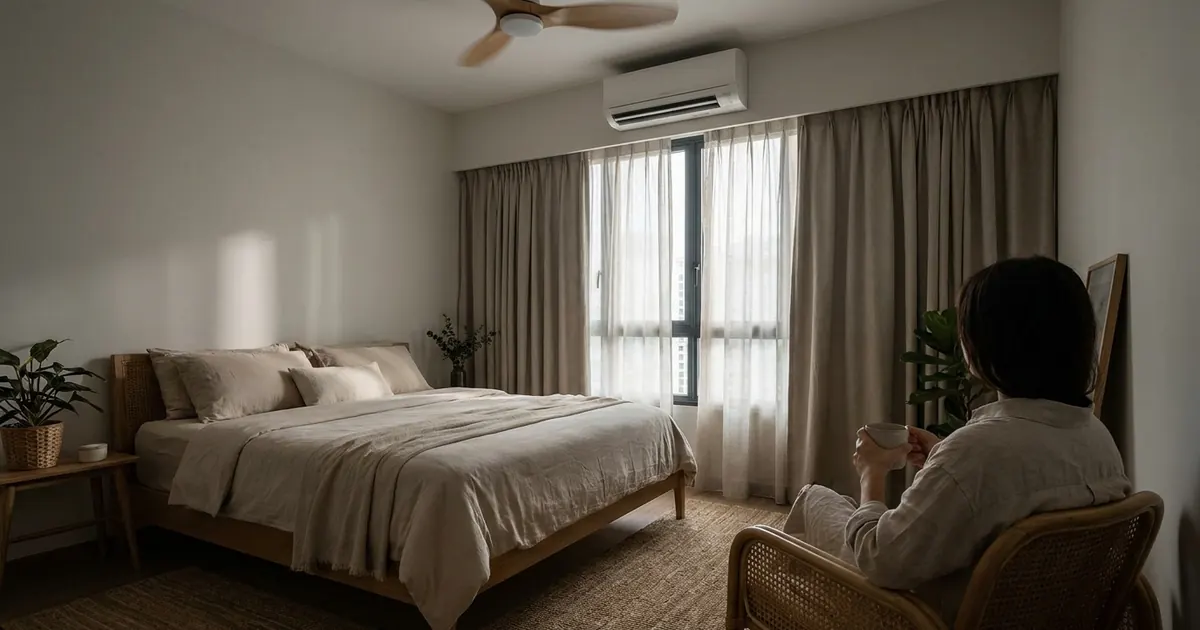
The quickest ways to lower your aircon bill are to set it at 25°C, let a fan share the work, shade the room from the afternoon sun and keep the filters clean. NEA estimates that each degree you raise the setting saves about 3% of a household's utility costs, and that switching to a fan for part of the night saves far more.
It adds up because aircon is a big slice of the bill. The Ministry of Sustainability and the Environment notes that air-conditioning makes up nearly a quarter of average household energy consumption. Here is what makes the difference, with NEA's own figures.
Start with the setting: 25°C
NEA's advice is to set the temperature at 25°C, and it adds that the lower the setting, the more energy the aircon uses. For every degree raised, it estimates a saving of about 3% of utility costs.
The same 25°C is the target of Go 25, the national movement launched in May 2025 by the Singapore Green Building Council and the Ministry of Sustainability and the Environment, supported by NEA and BCA. It encourages people to set indoor air-conditioning at 25°C or above, in homes as well as offices, and points out that pairing a higher setting with fans can save even more energy.
If 25°C feels warm at first, raise the setting one degree at a time over a few nights, with a fan running alongside the aircon.
Let a fan do some of the work
NEA's estimates for the fan habits are the biggest on its list:
| Habit | NEA's estimated saving on utility costs |
|---|---|
| Use a fan instead of the aircon | About 26% |
| Run the aircon for about an hour to cool the room, then switch to a fan | About 23% |
| Raise the aircon setting by one degree | About 3% per degree |
| Set the timer to turn the aircon off half an hour earlier | About 2% |
NEA bases these on its own assumptions, including a typical 4-tick single-split aircon and a small fan, so your savings will vary with your unit and your habits. The order is worth noticing: the fan habits beat everything else on the list.
The timer trick works because, as NEA puts it, a room continues to stay cool for a while after the aircon is turned off. Setting it to stop half an hour earlier than usual uses that leftover cool instead of paying for more.
Keep the heat out and the cool in
- Shade the windows. NEA suggests closing curtains or blinds during the hottest part of the day, or using solar window film. Rooms with windows facing east or west catch the most direct sun, so start there.
- Close the room. Keep doors and windows shut while the aircon runs. NEA's ventilation guidance for buildings makes the same point the other way round: when windows and doors are open, turn the aircon down or off.
- Cool only the room you are in. Close the doors to unused rooms rather than cooling the whole flat.
- Watch for extra heat. NEA lists large windows, windows facing east or west, and heat sources such as bar fridges among the things that make a room harder to cool.
When the air outside is pleasant, in the evening or after rain, skip the aircon altogether. NEA notes that opening doors and windows improves ventilation at home, and that cross ventilation, with air flowing through a space from one side to the other, is significantly more effective than openings on one side only. NEA also suggests positioning a fan to blow air out of a window to increase the air exchange.
Keep the unit clean
A clogged filter or a dusty coil makes the unit work harder for the same cooling. NEA's advice is to check the air filter once a month and clean or replace it when necessary so the aircon runs efficiently, to service the units regularly, and to have them inspected once a year. HDB says the same of the outdoor unit: regular maintenance helps it last longer and keeps it running efficiently.
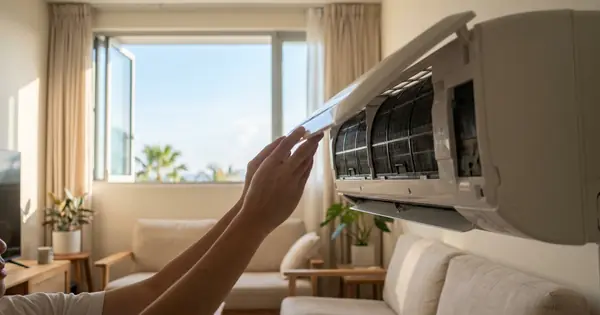
The monthly filter rinse takes a few minutes: switch off, lift the front panel, slide the filters out, rinse, dry in the shade and refit. For the coil and drain, a general aircon service every 3 to 4 months suits a unit in daily use; our guide on how often to service your aircon explains the schedule, and our pre-season aircon check shows how to spot a unit that is struggling.
If you are replacing an aircon
Buying a new unit is when efficiency matters most, because you live with the choice for years. NEA's buying advice covers three things.
The energy label. Household aircons supplied in Singapore must carry NEA's energy label, and NEA advises buying only registered models. It rates efficiency in ticks, from 1 tick (Low) to 5 ticks (Excellent), and more ticks means a more efficient model. Portable aircons are rated only from 1 to 2 ticks. The label also shows an estimated annual energy cost, which for an aircon NEA bases on 8 hours of use a day, so you can compare models directly.
The life cycle cost. NEA suggests looking at the purchase price plus the estimated electricity cost over the unit's lifespan, because the energy cost can be many times the purchase price. A cheaper, less efficient unit can cost more overall.
The right size. Oversized and undersized aircons both run less efficiently. NEA explains that an oversized unit costs more to run and may not dehumidify the room properly, because it cools too quickly, while an undersized one cannot keep up. Its rule of thumb is that the cooling capacity needed, in kW, is the room's floor area in square metres divided by 5, with more needed for high ceilings, large or sun-facing windows and extra heat sources. For a proper assessment, ask your supplier.
Where HomeMaster fits
We do not sell or install aircons, but we do keep them running well. General servicing covers the filters, accessible surfaces and drainage with a function test, and starts from $50 for one unit. If you service every 3 or 4 months anyway, a quarterly or tri-yearly plan reserves the dates and works out cheaper per visit than booking each one separately.
Book online, or tell Helen, our AI assistant on WhatsApp, how many units you have and anything you have noticed. She replies with real open slots and the exact total. Prices include GST, with no weekend surcharge and nothing extra for paying by card.
Frequently asked questions
What temperature should I set my aircon to in Singapore?
NEA recommends 25°C and estimates that each degree raised saves about 3% of utility costs. The national Go 25 movement encourages 25°C or above in homes, offices and buildings, and notes that pairing a higher setting with fans can bring even greater energy savings.
Does servicing my aircon reduce the electricity bill?
It helps the unit run efficiently, which is why NEA advises checking the filter monthly and servicing regularly, and why HDB says regular maintenance keeps a unit running efficiently. How much you save depends on how dirty the unit was, so be wary of anyone promising a fixed figure.
Is a 5-tick aircon worth the higher price?
It can be, over the life of the unit. NEA suggests comparing the life cycle cost, the purchase price plus the estimated electricity cost over the unit's lifespan, because the energy cost can be many times the purchase price. The energy label's annual energy cost figure makes that comparison easier.
Is it cheaper to use a fan than the aircon?
Yes, by a wide margin. NEA estimates that using a fan instead of the aircon saves about 26% of utility costs, and running the aircon for an hour before switching to a fan saves about 23%, based on its assumptions for a typical unit and fan.
Sources
- Energy Saving Tips by Appliance, National Environment Agency
- Tips on Buying Energy-Efficient Appliances, National Environment Agency
- The Energy Label, National Environment Agency
- Launch of Go25 National Movement, Ministry of Sustainability and the Environment
- Updated Guidance on Improving Ventilation and Indoor Air Quality in Buildings, National Environment Agency
- Maintaining Air Conditioners in HDB Flats, Housing & Development Board
Aircon due for a service?
See real open times and the exact total for your units before you book. GST included, and weekends cost the same as weekdays.