Get your aircon ready before Singapore's hottest months
May is Singapore's warmest month and April has the hottest afternoons. A quick aircon check to do in February or March, and when a unit needs a service.
By the HomeMaster team · · Updated · 5 min read
Check your aircon in February or March, before Singapore's warmest months arrive. Run each unit for 15 to 20 minutes and check the airflow, the smell, the noise and any drips, rinse the filters, and glance at the outdoor unit's brackets. If a unit is due for servicing or fails any of those checks, book it now, while you can still pick a time that suits you.
Here is when the heat comes, a simple check for each unit, and what the results mean.
When the heat arrives
Singapore is warm all year, but not evenly. On the Meteorological Service Singapore's long-term averages, December and January are the coolest months, with a 24-hour mean of 26.8°C. May is the warmest, at 28.6°C, and April has the highest average daily maximum, 32.4°C. June is nearly as warm as May.
The weeks after Chinese New Year are usually the calm before that. MSS describes the late part of the Northeast Monsoon, from late January to early March, as windy and relatively dry, and February is the driest month of the year. Then comes the inter-monsoon period from late March to May, when MSS notes that hot afternoons are common, with maximum temperatures above 32°C, alongside afternoon thunderstorms.
So a unit that coasted through the cooler months is about to work much harder, often for longer each night. A small problem in February, such as a slightly weak airflow or a faint smell, is likely to show itself properly in April.
A quick check for each unit
Do this for every unit, including the one in the spare room that has not been switched on for months.
- Run it. Close the doors and windows, set it to cool at your usual setting (NEA recommends 25°C) and leave it for 15 to 20 minutes.
- Feel the airflow. It should be strong, steady and clearly cold at the vents. Weak or lukewarm air often points to a clogged filter or coil.
- Smell it. A musty smell when the unit starts means growth on the damp coil, which a filter clean does not remove.
- Listen. Rattling, buzzing, clicking or grinding that was not there before is worth noting.
- Look. Check for drips from the unit, water stains on the wall below it, and black specks on the louvres.
- Test the controls. Make sure the remote, the timer and the modes you use all respond.
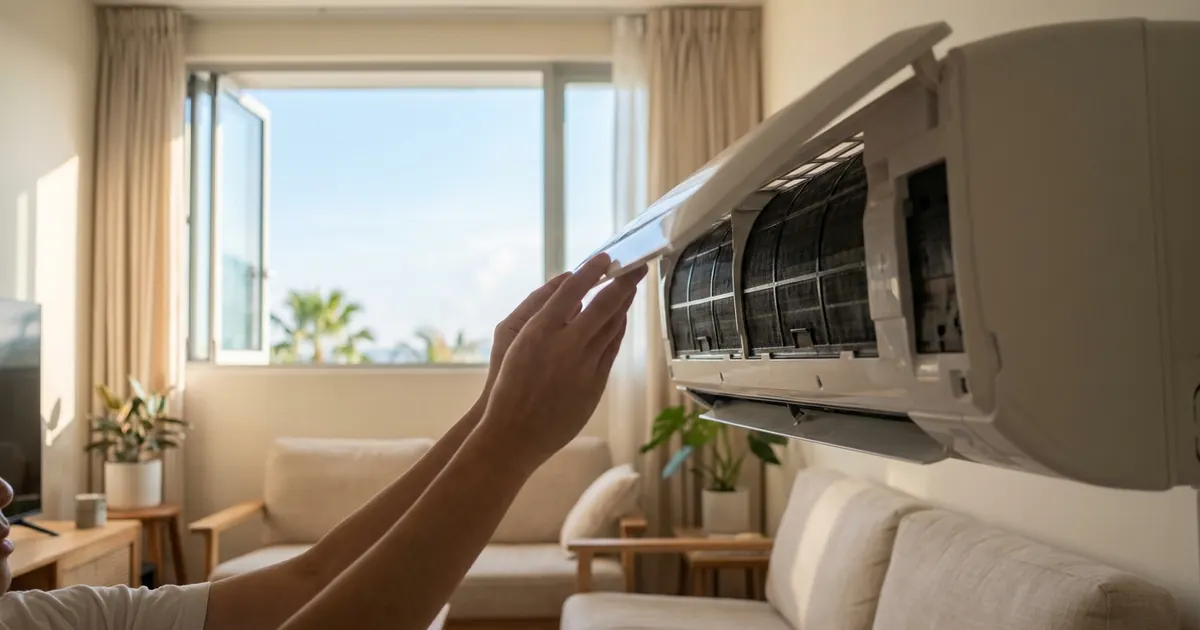
- Check the filters. Lift the front panel and slide the filters out. If they are dusty, rinse them, dry them fully in the shade and refit them. NEA advises checking filters once a month, so this should be quick if you have kept it up.
Write down anything odd, unit by unit. It saves time when you book, because the technician knows what to look at.
Do not forget the outdoor unit
The outdoor condensing unit is easy to ignore because you rarely see it. HDB's home-care guidance asks flat owners to:
- Monitor the stainless steel brackets that hold the unit up for signs of corrosion and rust
- Look out for any signs of leaking
- Make sure the piping is secure and runs into the flat, with the condensed water draining into a floor trap
HDB also suggests asking your aircon serviceman whether rusty or corroded brackets need replacing. This is a safety matter, not just an upkeep one: HDB warns that an aircon that is improperly installed or maintained can cause serious injury or death if it falls on someone below, and owners face a fine of up to 20,000 dollars, a jail term of up to a year, or both, if a unit or its supports fall because of a lack of maintenance.
Keep the space around the outdoor unit clear, so it can move air freely.
What the results mean
| What you found | What to do |
|---|---|
| Everything fine, and the last service was within 3 to 4 months | Nothing yet; keep up the monthly filter check |
| Everything fine, but a service is due | Book a general service |
| Weak cooling even with clean filters, or a musty smell | Book a chemical wash |
| Water dripping from the indoor unit | See our guide to an aircon leaking water |
| Smell back soon after a previous wash, or years without servicing | Book a chemical overhaul |
| Will not start, keeps tripping the circuit breaker, or grinds | Get it repaired; cleaning will not fix a failed part |
| Rusty brackets on the outdoor unit | Ask an aircon serviceman or installer, as HDB suggests |
If you are not sure which service a symptom calls for, our guide to general servicing, chemical wash and overhaul matches each one to what fixes it.
Why book before April
The check itself takes a few minutes a unit. The service, if you need one, is also quick: roughly 20 minutes a unit for general servicing, about 30 for a chemical wash and about an hour for an overhaul. What takes time is fitting it around your week, and that is easier in February, when nothing is urgent, than on the first stifling night in April, when a weak bedroom unit suddenly is.
It is also the natural point to set a rhythm for the year. For a unit in daily use, general servicing every 3 to 4 months keeps the coil and drain clear; our guide on how often to service your aircon explains why. A servicing plan books those visits for you: a quarterly plan covers 4 visits about 3 months apart, and a tri-yearly plan covers 3 visits about 4 months apart, with the dates reserved and confirmed before you pay.
Booking with HomeMaster
Book on our aircon servicing page, or send Helen, our AI assistant on WhatsApp, your unit count and what you noticed during your check. She replies with real open slots and the exact total for your units.
General servicing starts from $50 for one unit. Every price includes GST, weekends and public holidays cost the same as a weekday, and there is nothing extra for paying by card. Before the visit you get a reminder, you can ask Helen at any time who is coming, and afterwards a receipt arrives on WhatsApp.
Frequently asked questions
When is the hottest time of year in Singapore?
On the Meteorological Service Singapore's long-term averages, May is the warmest month, with a 24-hour mean of 28.6°C, and April has the highest average daily maximum at 32.4°C. The inter-monsoon period from late March to May brings hot afternoons above 32°C. December and January are the coolest months.
Can I service my aircon myself before the hot season?
You can do the filter part: NEA advises checking filters monthly and cleaning or replacing them when needed. The coil, drain tray and drain pipe need a technician's tools, so leave those to a proper service. Avoid spraying water or household cleaners into the unit.
My aircon has not been used for months. Is it fine to switch on?
Usually, but check it first. Rinse the filters, then run it for 15 to 20 minutes while you watch and listen. A musty smell, drips or strange noises mean it needs a service before you rely on it. A unit that sat idle through the cooler months is exactly the one to test.
What temperature should I set my aircon to?
NEA recommends 25°C and estimates that each degree you raise the setting saves about 3% of household utility costs. NEA also points out that the lower the temperature setting, the more energy the aircon uses, so a colder setting costs more every night of the hot season.
Sources
- Climate of Singapore, Meteorological Service Singapore
- Maintaining Air Conditioners in HDB Flats, Housing & Development Board
- Energy Saving Tips by Appliance, National Environment Agency
Aircon due for a service?
See real open times and the exact total for your units before you book. GST included, and weekends cost the same as weekdays.