How often should you service your aircon in Singapore?
Every 3 to 4 months for an aircon in daily use, and about twice a year for one in a rarely used room. Why humidity sets the pace, and the signs it is overdue.
By the HomeMaster team · · Updated · 5 min read
Service an aircon that runs every day once every 3 to 4 months. A bedroom unit that runs overnight most nights suits every 3 months, while a unit in a guest room or study that is rarely switched on can often stretch to about twice a year.
That is more often than many people expect, and the reason is the weather. The rest of this guide explains why, what you can do yourself between visits, and how to tell when a unit is overdue.
Why aircons in Singapore need servicing more often
An aircon does two jobs at once: it cools the air and it takes moisture out of it. NEA puts it plainly in its buying advice: air-conditioners control both the air temperature and the humidity. The moisture condenses on the cold coil inside the indoor unit, drips into a tray and runs out through a drain pipe.
In Singapore that happens all day, every day. The Meteorological Service Singapore records a mean annual relative humidity of around 82%, rising above 90% before sunrise and often reaching 100% during long spells of rain. So the coil is almost always wet.
A wet coil catches dust, and in a humid climate it grows a film of biological growth far faster than it would somewhere dry. The same slime collects in the drain tray and pipe. None of this stops the unit overnight. It slowly chokes the airflow, so the unit works harder for less cooling, and eventually the drain blocks or the smell arrives. HDB's home-care advice puts it simply: regular maintenance helps prolong an aircon's lifespan and keep it running efficiently.
A servicing schedule by how you use each unit
Use this as a starting point for each unit in your home.
| How the unit is used | How often to service it |
|---|---|
| Bedroom unit running overnight most nights | Every 3 months |
| Living room or bedroom unit used daily, a few hours at a time | Every 3 to 4 months |
| Guest room, study or spare room, switched on now and then | About twice a year |
Move towards the shorter end if any of these apply:
- The unit is near the kitchen, where cooking grease travels in the air
- You have pets that shed, since fur ends up on the filters
- There has been renovation or construction dust in or near the home
- Someone smokes indoors, or you have had a long spell of haze
- The home sits by a busy road
It is usually simplest to service every unit on the same visit. Our prices are set by the number of units on the visit, and for general servicing the cost per unit falls as the count goes up, so servicing them together also works out better.
What you can do yourself between services
NEA's energy advice is to check the air filter once a month and clean or replace it when necessary, so the unit runs efficiently. It also recommends servicing regularly and an inspection every year. The monthly filter check is the part you can do in a few minutes:
- Switch the unit off, at the wall switch if it has one.
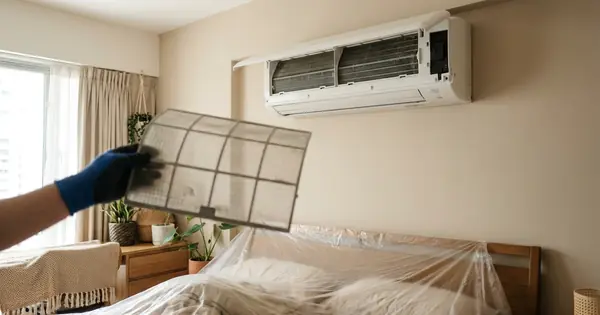
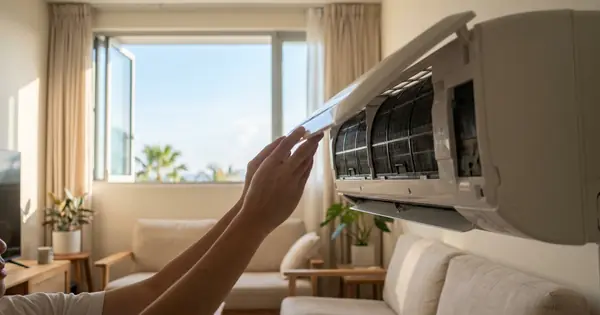
- Lift the front panel and slide the filters out.
- Rinse them under the tap, using a soft brush for stubborn dust.
- Let them dry completely in the shade before sliding them back in.
- Wipe the louvres and the front panel with a damp cloth.
Leave the coil, the drain tray and the drain pipe to a technician. Spraying water or household cleaner into the unit, or poking at the thin metal fins, can do more harm than good.
While you are at it, glance at the outdoor unit. HDB asks owners to watch the brackets holding it for rust, to look out for leaks, and to make sure the condensed water drains into a floor trap inside the flat.
Signs your aircon is overdue
A unit that needs attention usually tells you. Watch for:
- The room takes longer to cool, or the airflow feels weaker
- A musty smell when the unit starts
- Water dripping from the indoor unit
- New rattles, buzzing or other noise
- The unit tripping or stopping on its own
- Black specks on the louvres or around the vents
- A higher electricity bill with no change in how you use it
A routine general service handles the first stages of most of these. But a musty smell that a normal service does not fix, or cooling that stays weak after the filters are clean, usually means the coil needs a chemical wash. A unit neglected for years, or one leaking from a tray clogged with buildup, may need a full chemical overhaul. Our guide to general servicing, chemical wash and chemical overhaul matches each symptom to the service that fixes it.
What a general service includes
General servicing is the routine option for a unit that is cooling normally. The visit covers the filters and accessible surfaces, checks and clears the drainage, vacuums out the dust, and ends with a function test. It takes roughly 20 minutes a unit, so a four-unit general service is normally done inside 90 minutes.
It is maintenance, not a repair. A failing compressor or capacitor is a repair job, and no amount of cleaning will fix it. The same goes for refrigerant: a gas top-up only helps a unit that is genuinely low, and a unit that keeps running low has a leak that needs finding. Someone needs to let the technician in and be around at the end to confirm the work.
You can read more on our general aircon servicing page.
Servicing plans versus booking each time
If you know you will service every 3 or 4 months, a plan saves you remembering. HomeMaster offers two:
- Quarterly plan: 4 general servicing visits a year, about 3 months apart
- Tri-yearly plan: 3 general servicing visits a year, about 4 months apart
Both are paid upfront with the visit dates reserved, and you see and confirm those dates before paying. Both work out cheaper per visit than booking each service separately; the quarterly plan, for example, costs less than four one-off general services.
A single general service starts from $50 for one unit. Every price includes GST, there is no weekend surcharge, and there is nothing extra for paying by card.
Booking with HomeMaster
You can book on our aircon servicing page, or tell Helen, our AI assistant on WhatsApp, how many units you have and anything you have noticed, such as a smell or a drip. She replies with real open slots and the exact total for your unit count, not a range.
Before the visit you get a reminder, you can ask Helen at any time who is coming, and afterwards a receipt arrives, all on WhatsApp. If a unit turns out to need something other than a service, we will say so rather than sell you a visit that cannot help.
Frequently asked questions
Is servicing once a year enough in Singapore?
For a unit that runs every day, usually not. The coil stays damp in Singapore's humidity, so dust and growth build up within months. NEA recommends checking the filter monthly, servicing regularly and an inspection every year. For a unit in a rarely used room, about twice a year is a sensible starting point.
Can I just wash the filters myself instead of servicing?
Washing the filters monthly is worth doing and keeps air moving. But the filter is only the first layer. The coil, the drain tray and the drain pipe behind it collect dust and slime that a filter rinse never reaches, and those need a technician with the right tools.
Should I service all my aircon units at the same time?
Usually, yes, because one visit is simpler and, for general servicing, the cost per unit falls as the number of units on the visit goes up. If one unit runs far more than the others, such as a bedroom unit used every night, it is fine to service that one more often.
How long does aircon servicing take?
Roughly 20 minutes a unit for general servicing, so four units are normally done inside 90 minutes. A chemical wash takes about 30 minutes a unit and a chemical overhaul about an hour, because the unit is taken apart.
Sources
- Climate of Singapore, Meteorological Service Singapore
- Energy Saving Tips by Appliance, National Environment Agency
- Tips on Buying Energy-Efficient Appliances, National Environment Agency
- Maintaining Air Conditioners in HDB Flats, Housing & Development Board
Aircon due for a service?
See real open times and the exact total for your units before you book. GST included, and weekends cost the same as weekdays.