How to use cleaning products safely with kids and pets
Never mix products, keep them in their original bottles in a locked cabinet, ventilate, and let floors dry. Singapore's official advice for homes with children.
By the HomeMaster team · · Updated · 5 min read
The safest way to use cleaning products in a home with children or pets is to follow a few firm rules: never mix products, use one at a time as the label directs, keep every product in its original bottle, store them in a locked cabinet out of reach, and ventilate while you clean. Those rules come straight from Singapore's official guidance, and they matter more than which brand you buy.
This guide explains each rule and the reason behind it, what to do while you clean, how to choose gentler products, and what to do if something goes wrong. It is practical guidance, not medical advice; for a health concern, speak to a doctor or vet.
Rule one: never mix products
Some cleaning products react with each other, so the official advice is simple. The National Environment Agency (NEA) advises: do not mix different disinfectant products, and use them in a well-ventilated area. Its guidance for premises goes further, saying cleaning agents and disinfectants should not be mixed together, to avoid hazardous reactions.
In practice that means:
- One product per surface at a time. If you want to switch products, rinse the surface with water first.
- One product in the toilet bowl. Pick one, and flush well before anything else goes in.
- No topping up. Never refill a spray bottle of one product with another, even if both are cleaners.
- No homemade blends. Recipes that combine household products are exactly what the guidance warns against.
Read the label, then follow it
The label is the most important safety document you own. NEA advises checking the label, using a product according to its instructions, and being aware of the potential hazard of each product. The Consumer Product Safety Office adds that following the manufacturer's instructions may include ventilating the room and wearing gloves or goggles.
Three label habits make a difference:
- Dilute exactly as directed. More product does not clean better; it leaves residue and fumes.
- Respect the contact time. Many disinfectants only work if left on the surface for a set time. Wiping straight off wastes them.
- Check where the product may be used. Some are not for food-contact surfaces, or need rinsing afterwards.
Storage that actually works
Cleaning products can look tempting to a child: the Consumer Product Safety Office points out that they often come in brightly coloured packaging that looks attractive to children.
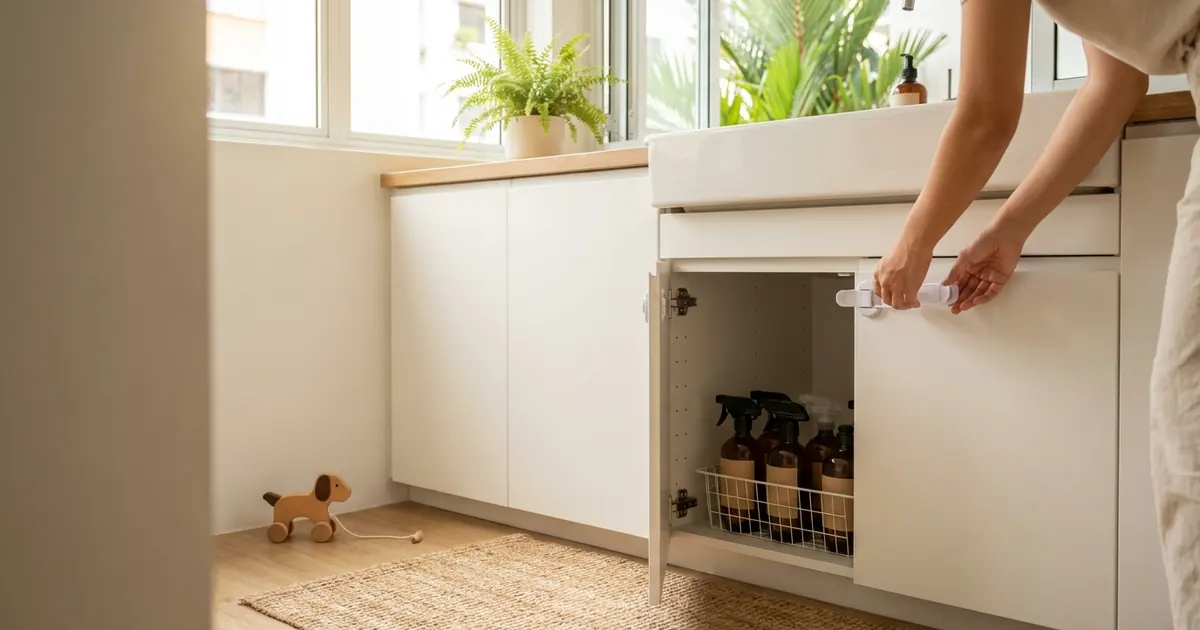
- A locked cabinet out of reach. The Consumer Product Safety Office advises storing chemicals in a cabinet children cannot reach, kept locked at all times. HealthHub's advice for parents is to lock bathroom and kitchen cabinets so children cannot get to liquids such as cleaning detergents or bleach.
- Original containers only. HealthHub advises keeping cleaning products in their original containers so children do not mistake them for something edible. The Consumer Product Safety Office warns against reusing empty containers or repacking chemicals into other containers, which can lead to mistaken use or accidental swallowing.
- Watch the under-sink cupboard. It is a common weak spot in HDB and condo kitchens and bathrooms: low, easy to open, and full of products. Fit a child lock or move the products higher.
- Never leave products out during use. The Consumer Product Safety Office advises not leaving chemicals unattended while you use them. Take the caddy with you from room to room.
While you clean: children and pets
- Clean when children are out or in another room, especially with stronger products.
- Ventilate. NEA's guidance for homes is to let fresh air into the room during and after cleaning and disinfection.
- Keep everyone off wet floors until they are dry, both to avoid slips and because small hands and paws touch the floor and then mouths.
- Rinse surfaces children touch or mouth, such as high chair trays and low tables, when the label says to.
- After spraying insecticide, HealthHub advises keeping children away from the area and only letting them back once it has been cleared up.
- Think about pets too. They walk on freshly cleaned floors and lick their paws; our guide to cleaning with pets covers pet-safe routines and the houseplants NParks lists as harmful.
Choosing gentler products
You need fewer products than the supermarket aisle suggests. Warm water and a microfibre cloth handle a lot of routine dusting and wiping. Mild dishwashing liquid deals with light grease. Keep the strong products, such as bleach, oven cleaner, drain cleaner and limescale remover, for the specific jobs that need them, and use them sparingly.
Labels such as natural, green or eco are not a safety rating. A product made from plant ingredients can still irritate skin or eyes, and some common kitchen staples used for cleaning are acidic. Read the hazard warnings on the back rather than the claims on the front. Our guide to the supplies to have ready explains what your cleaner brings, what you provide, and which products suit which surfaces.
If something goes wrong
If a child may have swallowed a product. HealthHub advises seeking medical attention immediately and not feeding the child anything, as it may worsen the symptoms. Note the time and what was swallowed, because the medical team will ask; taking the bottle or a photo of its label makes that easy. In an emergency, call 995 for an ambulance.
If a product splashes on skin or into eyes. Follow the first aid directions on the label and seek medical advice. NEA's general advice is to avoid contact with eyes and skin when handling disinfectant products, which is why gloves are worth wearing.
If a pet may have swallowed a product or a plant. Call your vet straight away.
How it works with HomeMaster
With HomeMaster, your cleaner uses a multi-purpose cleaner they bring as part of their kit. If you want a particular product used around your children or pets, or a product avoided, leave yours out and tell Helen, our AI assistant on WhatsApp, so your cleaner knows before the visit. If you leave out a product of your own, say where it goes back afterwards, such as the locked cabinet, so nothing is left within reach.
If your bathrooms tend to need stronger products, our guide to cleaning bathroom grout in a humid home shows how to keep them fresh with one product at a time. The home cleaning checklist shows what each room covers.
Frequently asked questions
Is it safe to mix bleach with another cleaner to make it stronger?
No. Do not mix cleaning products. NEA advises against mixing different disinfectant products, and its guidance for premises says cleaning agents and disinfectants should not be mixed together, to avoid hazardous reactions. Use one product at a time, rinse between products, and keep the room ventilated.
Are natural cleaning products safe for babies?
Not automatically. Words such as natural or eco are not a safety rating, and plant-based products can still irritate skin or eyes. Read the hazard warnings on the label, use as directed, rinse surfaces a baby touches or mouths when the label says to, and store every product locked away.
What should I do if my child swallows a cleaning product?
HealthHub advises seeking medical attention immediately and not feeding the child anything, as it may worsen the symptoms. Note the time and the product, and take the bottle or a photo of the label so you can tell the doctor exactly what it was. In an emergency, call 995.
Where should I store cleaning products in a small HDB flat?
Somewhere high, or in a cabinet with a child lock, and kept locked, as the Consumer Product Safety Office advises. Avoid the open cupboard under the sink unless you fit a lock. Keep every product in its original container and put the caddy away straight after cleaning.
Sources
- List of Active Ingredients for General Disinfection, National Environment Agency
- Environmental Sanitation for High-Risk Non-Healthcare Premises in Singapore (November 2024), National Environment Agency
- Guidelines for Cleaning and Disinfecting Residences, National Environment Agency
- Safety Tips for Storing Household Chemicals, Consumer Product Safety Office
- Keep Your Home Free From These Safety Hazards, HealthHub (Health Promotion Board)
- Keeping your child safe, HealthHub (Health Promotion Board)
- Civil Defence Emergency Handbook (10th edition), Singapore Civil Defence Force
Need a hand at home?
Tell Helen what you need on WhatsApp. She replies with real open times and the exact price, GST included, and weekends cost the same as weekdays.