How to protect your home from haze in Singapore
Close windows when readings worsen, clean with damp cloths instead of dusters, look after aircon filters, and do a proper wipe-down once the haze lifts.
By the HomeMaster team · · Updated · 5 min read
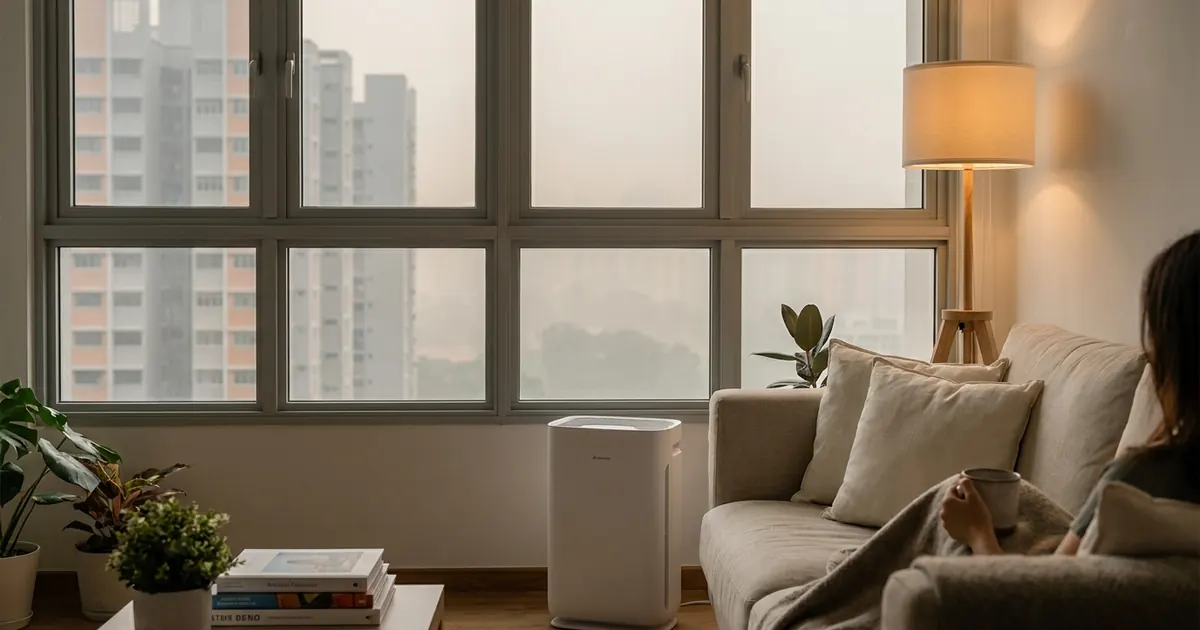
When haze arrives, close your doors and windows as soon as the outdoor air starts getting worse, clean with damp cloths and a mop rather than a duster, and let a portable air purifier or your aircon do the work indoors. When the air clears, reopen the windows and give the home a proper top-to-bottom wipe-down, including the aircon filters.
Haze is not a daily fact of life here, but it does return. NEA says transboundary haze is more likely during the Southwest Monsoon months, which the Meteorological Service Singapore dates from June to September, and it does not always stop on time: NEA's update on 28 September 2026 reported moderate to dense smoke haze from fires in southern Sumatra and Kalimantan drifting to Singapore. This guide covers what the readings mean for your home, how to keep particles out, and how to clean up afterwards.
What the readings mean
NEA publishes two readings, and each has a different use. The 1-hour PM2.5 reading shows the air right now, so use it for decisions such as whether to open the windows this hour. The 24-hour PSI forecast is for planning the next day.
| 24-hour PSI | Descriptor |
|---|---|
| 0 to 50 | Good |
| 51 to 100 | Moderate |
| 101 to 200 | Unhealthy |
| 201 to 300 | Very unhealthy |
| Above 300 | Hazardous |
The 1-hour PM2.5 reading, measured in micrograms per cubic metre, has four bands: Normal (0 to 55), Elevated (56 to 150), High (151 to 250) and Very high (251 and above).
You can check both on NEA's haze website or the myENV app. For health advice by reading, including for the elderly, pregnant women, children and anyone with a heart or lung condition, follow the activity guide on HealthHub rather than a cleaning guide like this one.
Keeping the haze out
NEA and the Ministry of Health give the same practical tips for households:
- Close doors and windows when the outdoor air quality appears to be getting worse
- Reopen them when the outdoor air quality improves
- Cut other sources of indoor pollution, such as cigarettes and candles
- Use fans or the aircon for air circulation and cooling
- If your aircon draws in unfiltered air from outside, as window units do, close the outdoor air intake
A typical wall-mounted split aircon cools the room's own air rather than drawing air in from outside; NEA's ventilation guidance groups split units with systems that have no fresh air supply. That is why the advice singles out window units, and why running a split unit with the windows shut is fine.
Two small habits help too. Run the cooker hood when you cook with the windows closed, and keep the main door shut as much as you can on the worst days.
Air purifiers and your aircon
Portable air purifiers can bring the indoor particle level down further, according to NEA and HealthHub. They work on an enclosed space, so they help most in a room with the door and windows shut. A few points from NEA's guidance on choosing and using one:
- Look at the clean air delivery rate (CADR). A higher CADR means the unit returns more clean air, and it needs to match the size of the room.
- Choose one with a high-efficiency filter such as a HEPA filter.
- If it has an ozone-generating function, turn that off.
Put the purifier where people spend the most time with the door closed, often the bedroom at night.
Your aircon's filters catch dust too, so they can clog faster during a long haze. A clogged filter cuts airflow and makes the unit work harder. NEA's general advice is to check aircon filters once a month and clean or replace them when necessary; during and after a hazy spell, check them sooner. If the unit is due anyway, a general aircon service cleans the filters and surfaces and checks the drainage, and our guide to how often to service your aircon covers the usual schedule.
Cleaning during the haze
Particles that get in settle on floors, sills and ledges. HealthHub notes that wet-cleaning methods such as mopping and wiping generally do not produce dust, unlike dry dusting or vacuuming, and can be used to remove settled dust. So during haze:
- Wipe with a damp microfibre cloth, rinsing it often, instead of a feather duster
- Mop instead of sweeping
- If you do vacuum, keep windows shut and mop afterwards
- Start with the surfaces closest to windows and doors: sills, window tracks, ledges and the floor in front of the balcony door
Resist the urge to air the home out after cleaning while readings are still high. Wait until the 1-hour PM2.5 reading has come back down.
If the haze is heavy, you may prefer to dry laundry indoors for a few days rather than on the corridor rack or balcony.
Cleaning up after the haze lifts
Once the air has cleared and you have reopened the windows, give the home one thorough pass. Work from the top of each room down, so dust you knock off high surfaces lands on floors you have not cleaned yet:
- Fan blades and light fittings
- Tops of wardrobes, shelves and door frames
- Window grilles, frames, tracks and sills, inside and on the balcony
- Tables, counters and other surfaces
- Cushion covers, throws and anything fabric you can wash
- Floors last, vacuumed and then mopped
Then look after the equipment. Rinse the aircon filters and let them dry fully in the shade, check the purifier's filter against its manual, and wipe the doormats and shoe rack by the door.
How HomeMaster can help
A post-haze reset is a good use of a one-off session. A 3 to 4 hour visit gives a cleaner time for window tracks, sills, ledges, fans and floors on top of the usual rooms, and you can tell Helen, our AI assistant on WhatsApp, which rooms to start with. Our cleaners work to a written standard across the whole home; see what a visit covers on our home cleaning page. You provide a working vacuum cleaner and mop; your cleaner brings the cloths, brushes and a multi-purpose cleaner.
For the aircon, you can book general servicing online, and if a unit smells musty or cools weakly after the haze, tell Helen and she will point you to the service that fits. Prices include GST, and there is no weekend surcharge and no card surcharge.
Frequently asked questions
Should I switch off my aircon during the haze?
No need. NEA says fans or air-conditioners may be used for air circulation and cooling during haze. The exception is a unit that draws in unfiltered outdoor air, such as a window unit, where you should close the outdoor air intake. Check the filters more often than usual, because they catch extra dust.
Do I need to wear an N95 mask at home during the haze?
HealthHub says N95 masks are not needed in an indoor environment, and are also not needed for short exposure such as a commute. Keeping doors and windows closed when the air worsens, and using a portable air purifier, are the indoor measures NEA and MOH recommend.
When is it safe to open the windows again?
NEA's advice is to reopen doors and windows when the outdoor air quality improves. Check the 1-hour PM2.5 reading on the haze website or the myENV app; it reflects the air right now, so it is the one to use for this kind of decision.
Does an air purifier work if the windows are open?
Not well. NEA describes portable air cleaners as designed to keep particle levels low in an enclosed space. With windows open, outdoor air keeps replacing the air it has cleaned. Close the room, match the purifier's clean air delivery rate to the room size, and turn off any ozone function.
Sources
- Haze: 24-hr PSI and 1-hr PM2.5 readings, National Environment Agency
- Air pollution FAQs, National Environment Agency
- Climate of Singapore, Meteorological Service Singapore
- Haze Situation Update (28 September 2026), National Environment Agency
- How to Protect Yourself Against the Haze, HealthHub (Ministry of Health)
- Air Cleaning Devices, National Environment Agency
- Updated Guidance on Improving Ventilation and Indoor Air Quality in Buildings, National Environment Agency
- Energy Saving Tips by Appliance, National Environment Agency
Aircon due for a service?
See real open times and the exact total for your units before you book. GST included, and weekends cost the same as weekdays.