Dengue prevention at home: a weekly check for Singapore homes
Aedes mosquitoes breed in clean, still water as small as a 20-cent coin. NEA's B-L-O-C-K steps and a short weekly walk-through keep your home clear.
By the HomeMaster team · · Updated · 6 min read
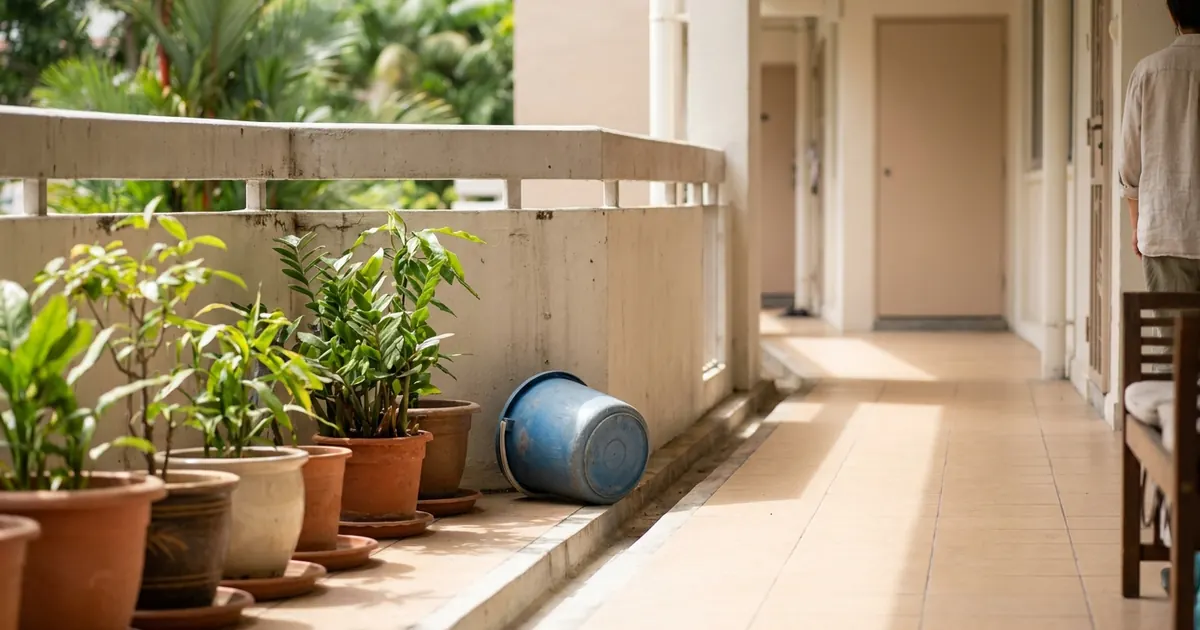
The most useful thing you can do against dengue at home is to remove stagnant water at least once a week, every week. NEA calls this the Mozzie Wipeout and sums it up as B-L-O-C-K: break up hardened soil, lift and empty flowerpot plates, overturn pails and wipe their rims, change water in vases, and keep roof gutters clear and place BTI insecticide. In most flats a careful walk-through takes only a few minutes.
Below is why small amounts of water matter, a spot-by-spot check built from NEA's own checklist, how to see whether you live in a dengue cluster, and what a cleaner can and cannot help with.
Why a little water is enough
Dengue is spread by the Aedes mosquito, which NEA describes as easy to identify by the black and white stripes on its body. It prefers to breed in clean, stagnant water of the kind easily found in homes, and NEA says water as small in volume as a 20-cent coin is enough for mosquitoes to breed.
That is why a home that looks spotless can still breed mosquitoes. The risk is rarely a big puddle. It is the saucer under a plant, the pail left upright in the service yard, or the vase nobody has touched since the weekend. NEA also notes that Aedes mosquitoes mainly bite during the day, so daytime habits indoors matter as much as evening ones.
NEA's B-L-O-C-K steps, explained
- Break up hardened soil. Loosen the soil in potted plants so water cannot sit on a hard, crusted surface.
- Lift and empty flowerpot plates. NEA's checklist says to remove the water every other day and scrub the plate to remove mosquito eggs, or to stop using plates if you can.
- Overturn pails and wipe their rims. Store pails and watering cans upside down and under shelter when they are not in use.
- Change water in vases. NEA says every other day, scrubbing the inner sides and washing the roots of flowers and plants, because eggs stick to them easily.
- Keep roof gutters clear and place BTI insecticide. This mostly applies to landed homes: clear fallen leaves from gutters and add insecticide as NEA directs.
In NEA's lists for 2023, 2024 and 2025, the top three breeding habitats found in homes were the same every year: pails, flower pot plates and trays, and vases. Get those three right and you have covered most of the risk in a typical home.
A weekly check, spot by spot
NEA's Checklist for a Mozzie-Free Home sorts the work by how often it needs doing. Here it is as a table you can work through:
| Spot | What NEA asks | How often |
|---|---|---|
| Pails and watering cans | Turn them over and store them under shelter | At all times |
| Potted plants | Loosen hardened soil | At all times |
| HDB corridor scupper drains | Do not block them with pots or other items | At all times |
| Gully traps you rarely use | Cover them, or fit non-perforated traps with an anti-mosquito valve | At all times |
| Bamboo pole holders | Cover them after use | At all times |
| Aircon units | Do not place trays or containers under or on top of them | At all times |
| Flower pot plates | Remove the water and scrub off eggs, or avoid using plates | Every other day |
| Vases | Change the water, scrub the inside, wash flower roots | Every other day |
| Scupper drains and garden | Clear fallen leaves and stagnant water | Once a week |
| Air cooler | Clear any stagnant water | Once a week |
| Vases, gully traps, roof gutters | Add the prescribed amount of sand granular insecticide, even if dry | Once a month |
| Roof gutters and apron drains | Clear fallen leaves | Once a month |
On the aircon point, NEA explains that trays under or on top of an aircon unit can create conditions that favour breeding. If you need a tray for another reason, it says to use HDB's patented air-conditioner tray and to keep checking that its drainage point is not choked.
For a flat, a practical order is to start at the front door and walk the home once: corridor plants and the scupper drain, then the vases in the living room, the pails in the kitchen and service yard, the bathrooms, and finally the plants and bamboo pole holders at the windows or balcony. Doing it on the same day every week, such as Sunday evening or the day before your cleaner comes, is what makes it stick.
Check whether you live in a dengue cluster
NEA publishes a map of dengue clusters, with the map data updated at 1am. A cluster forms when two or more cases have onset within 14 days and are located within 150m of each other, based on home and workplace addresses. Each cluster carries an alert level:
- Red: a high-risk area with 10 or more cases
- Yellow: a high-risk area with fewer than 10 cases
- Green: no new cases, and under surveillance for the next 21 days
You can search the NEA dengue clusters page by locality, or download NEA's myENV app for notifications about clusters.
NEA encourages all residents, especially those living in cluster areas, to carry out three protective actions, which it calls S-A-W: spray insecticide in dark corners around the house, apply insect repellent regularly, and wear long-sleeved tops and long pants. It also suggests sleeping under a mosquito net if you sleep during the day, and installing mosquito screens on windows and doors. NEA says repellents with DEET, picaridin or IR3535 as the active ingredient are the most effective.
If an NEA officer comes to your door
NEA officers carry out dengue inspections of homes. According to NEA, an officer identifies themselves with an NEA Authority Card, explains the purpose of the visit, and enters only with your consent and with you accompanying them. You can verify an officer's identity through NEA's website or by calling NEA on 6225 5632.
If they find breeding, they show you the habitat and collect a sample of the larvae or pupae in a vial that is sealed in front of you. NEA asks you not to pour the water away before they do. Breeding mosquitoes is an offence, and NEA says any fine is issued later, with owners or occupiers told by mail; officers do not ask for payment on the spot. Anyone demanding money at your door is a reason to stop and verify.
What a cleaner can help with, and what stays with you
A regular clean already covers some of the places where water collects. The written standard our cleaners work to includes the bathroom floor and drain areas, the kitchen sink and its drain, and the balcony floor and drain area, so these are cleared and wiped as part of a normal visit. You can see the full scope in our home cleaning checklist.
A cleaner also moves through parts of your home you might not look at every day: under the sink, around the service yard, behind the plants on the balcony. If they come across standing water, such as a full pail or a saucer under a plant, it is reasonable to ask them to tip it out and tell you where it was. You can also ask them to store the mop pail upside down after use.
What a cleaner does not do is a dengue inspection. The weekly Mozzie Wipeout belongs to the household, because it needs to happen every week whether or not anyone is booked, and parts of it, such as adding insecticide to gully traps and gutters, are not part of a clean. We do not offer pest control. If mosquitoes keep appearing after you have followed NEA's steps, that is work for a pest control company.
If you would like your cleaner to keep an eye on particular spots, such as the plant saucers on the balcony, tell Helen, our AI assistant on WhatsApp, before the visit and she will pass the note on. For what a standard visit covers room by room, read what a home cleaner does, or see our home cleaning service.
Frequently asked questions
How often should I check my home for mosquito breeding?
NEA asks households to do the Mozzie Wipeout at least once a week. Some spots need more often: NEA's checklist says to empty flower pot plates and change vase water every other day, and to add sand granular insecticide to vases, gully traps and roof gutters once a month, even when they are dry. Pails and watering cans should be kept turned over at all times.
Can a small amount of water really breed mosquitoes?
Yes. NEA says Aedes mosquitoes can breed in clean, stagnant water as small in volume as a 20-cent coin. That is why the usual culprits in homes are small containers: pails, flower pot plates and trays, and vases were the top three breeding habitats NEA found in homes in each of 2023, 2024 and 2025.
How do I know if I live in a dengue cluster?
Check the dengue clusters page on NEA's website, which you can search by locality and whose map data is updated at 1am, or use NEA's myENV app for notifications. A red alert means 10 or more cases, yellow means fewer than 10, and green means no new cases while the area stays under surveillance for 21 days.
Will my cleaner check my home for mosquito breeding?
Not as a service. A normal clean covers bathroom and balcony drain areas and the kitchen sink, and a cleaner who comes across standing water can tip it out and tell you. The weekly Mozzie Wipeout, including insecticide in gully traps or gutters, stays with the household, and pest control is a separate specialist service that HomeMaster does not offer.
Sources
- Stop Dengue Now, National Environment Agency
- Prevent Aedes Mosquito Breeding, National Environment Agency
- Other Preventive Measures: Checklist for a Mozzie-Free Home, National Environment Agency
- Know the Potential Aedes Breeding Sites, National Environment Agency
- Dengue Clusters, National Environment Agency
- Inspecting your homes and premises for mosquito habitats, National Environment Agency
Need a hand at home?
Tell Helen what you need on WhatsApp. She replies with real open times and the exact price, GST included, and weekends cost the same as weekdays.