How to let your cleaner in when you are not home
You do not need to be home for a clean. Pick a safe way in, register the visit with condo security, settle pets and valuables, and be open about cameras.
By the HomeMaster team · · Updated · 5 min read
You do not need to be home while your home is cleaned, and many households are at work during the visit. What you need is a plan for four things: how the cleaner gets in, how they get past condo security if you have it, what happens with pets and valuables, and how you handle cameras. Sort these out once and every visit after that is simple.
Choosing how your cleaner gets in
The right option depends on your door, your building and how often the cleaner comes.
| Option | Works well when | Watch out for |
|---|---|---|
| A separate digital lock code | You have a digital lock that allows extra user codes | Delete or change the code if the arrangement ends |
| A key with a neighbour or relative | Someone you trust is home during the day | Their schedule becomes part of yours |
| A key box with a code | You cannot change the lock, and the box is out of sight | The code is only as private as the people who know it |
| You let them in, then leave | The first visit, when you want to show them around | It only works if you are free at the start time |
| A key under the doormat or in the meter box | Never | These are the first places anyone looks |
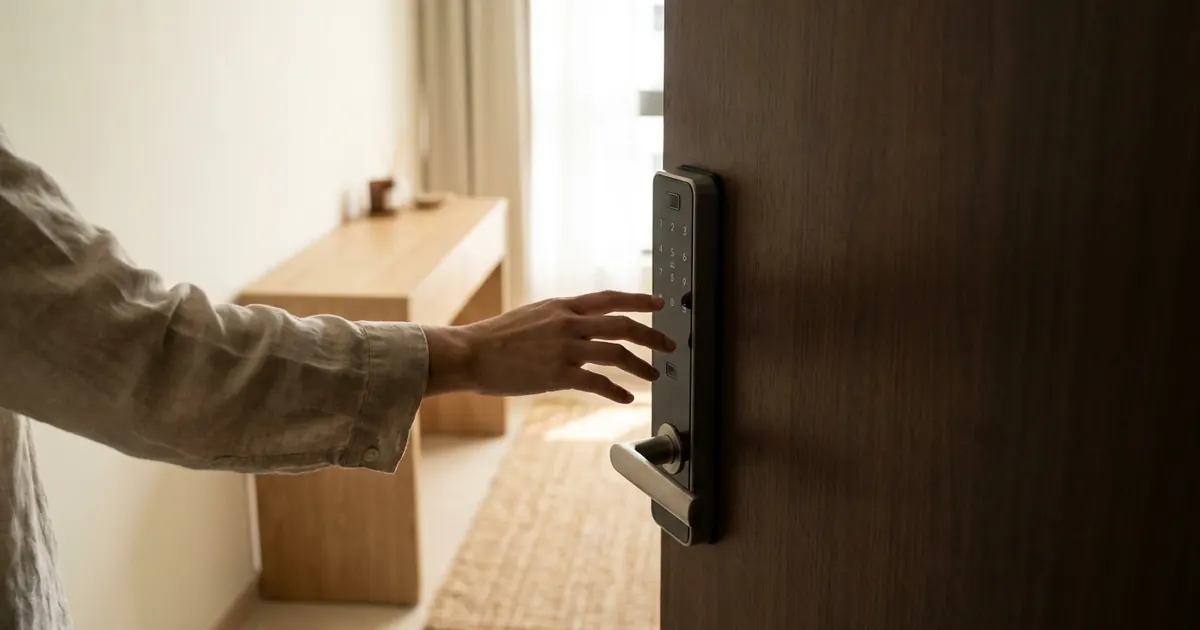
A separate code is usually the tidiest option, because it can be removed without affecting anyone else in the household, and some locks also record which code was used. Give your cleaner a code of their own, never yours.
A note on digital locks
If you are installing a digital lock to make access easier, check it is suitable for your door. The Singapore Civil Defence Force points out that main doors of HDB flats and condominium units are examples of fire-rated doors, and since 1 March 2024 a digital lock installed on a fire door must be certified for fire resistance. SCDF also advises choosing one with a mechanical fail-safe, so the door can still be unlocked from inside if the battery dies.
Condo security and visitor registration
In a condo, the guardhouse will need to know your cleaner is coming. Register the visit ahead of time through your condo's app or with the guards, with the cleaner's name and the time of the visit. For a regular slot, ask the management office whether a recurring visitor can be registered once.
Guardhouses sometimes ask for identity documents. The Personal Data Protection Commission (PDPC) says organisations are generally not allowed to collect full NRIC numbers unless the law requires it or they must verify identity to a high degree of fidelity. Its guidelines use a condo as an example: the management corporation could check a visitor's ID and record their name, a partial NRIC (the last three digits and the letter), contact number or vehicle number, preferably in a password-protected system rather than an open logbook.
PDPC also advises that organisations should generally not keep a person's physical NRIC unless the law requires it, and that the same applies to other ID documents such as a work pass. So your cleaner should not have to leave their card at the gate.
Pets
Tell the service about pets when you book, and again if anything changes. A friendly dog is not a problem for most cleaners, but a nervous one, or a cat that darts out of an open door, needs a plan.
- Shut anxious animals, or those likely to slip out, in a room with water and a note on the door.
- Say which doors must stay closed, especially the main door and any gate.
- Put away pet medicines, and say if any cleaning product should not be used around a pet.
Do not expect a cleaner to walk, feed or handle your animals. That is a different service.
Valuables and private spaces
Treat the visit as you would any time someone is in your home while you are out. The Singapore Police Force advises against keeping large amounts of cash at home and suggests keeping valuables and important documents in a secure, discreet place, such as a safe bolted to the structure.
- Put cash, jewellery, watches, passports and documents away before the visit.
- Close or lock a home office or any room you would rather was not cleaned, and say so.
- Point out anything fragile or valuable in plain view, such as a collectible or an heirloom vase, so it is dusted with care or left alone.
Clear instructions protect your cleaner as much as you. If they know exactly what is off limits, nobody has to wonder later.
Cameras and privacy
Many homes now have an indoor camera or a video doorbell. It is reasonable to want to see your home while you are out, and it is fair to be open about it.
- Say that there are cameras. Tell the service or your cleaner. It avoids an awkward discovery and shows respect.
- Keep cameras out of private areas. For workplaces, MOM's guidance is that such devices should only be used where there are safety and security concerns, and not in private areas such as restrooms. The same common sense applies at home.
- Use footage for its purpose. A recording of someone at work in your home is not something to post online.
On the legal side, PDPC's guidelines explain that an individual acting in a personal or domestic capacity is not required to comply with the data protection provisions of the Personal Data Protection Act. That describes whom the law's obligations fall on. It is not a reason to point a camera somewhere private.
What to leave ready
A few things make an unsupervised visit go smoothly:
- The vacuum cleaner and mop in one place, plus any special product your surfaces need (with us, your cleaner brings the cloths and a multi-purpose cleaner)
- A short note of priorities for this visit
- How to lock up and where to leave the key, if a key is used
- A way to reach you if something is unclear
How it works with HomeMaster
You do not need to be home for a clean. Tell Helen, our AI assistant on WhatsApp, how your cleaner will get in, and she confirms the access arrangements with you before the visit. You can ask her at any time who is coming.
Every cleaner is background checked and reference verified before their first job, and damage is covered up to a stated cap per item. For a regular slot we aim to keep the same cleaner where possible, which means fewer people need your access details; our guide on why the same cleaner matters explains how that works. You can see what a visit covers on our home cleaning page, and how we handle your details in our privacy policy.
Frequently asked questions
Is it safe to give my cleaner my digital lock code?
Give them a separate code rather than your own, if your lock allows more than one. You can then delete or change it when the arrangement ends without affecting anyone else, and some locks record which code was used. Avoid writing the code anywhere near the door.
Do I need to be home for the first clean?
No, but it helps if you can be there at the start. A few minutes showing where things are, which surfaces need care and which rooms to skip saves time on the first visit. After that, a clear note of priorities and a reliable way in are usually enough.
Can the condo guardhouse keep my cleaner's IC?
PDPC's guidelines say organisations should generally not keep a person's physical NRIC unless the law requires it, and that the same applies to other ID documents such as a work pass. For visitor records, PDPC's own condo example records a name and a partial NRIC rather than the full number.
Should I tell my cleaner about home cameras?
Yes. It is the respectful thing to do and avoids an awkward discovery. Keep cameras out of bathrooms and other private areas, and use any footage only for what it is for, keeping your home safe, rather than sharing it.
Sources
- Digital Locksets on Fire-rated Doors, Singapore Civil Defence Force
- Advisory Guidelines on the PDPA for NRIC and other National Identification Numbers, Personal Data Protection Commission
- Advisory Guidelines on Key Concepts in the Personal Data Protection Act (revised 29 April 2026), Personal Data Protection Commission
- Housebreaking advisory, Singapore Police Force
- Oral answer to PQ on guidelines for CCTVs at workplaces, Ministry of Manpower
Need a hand at home?
Tell Helen what you need on WhatsApp. She replies with real open times and the exact price, GST included, and weekends cost the same as weekdays.