The 75-point home cleaning checklist, explained
Our written standard checks six areas of a home, bathrooms first, in 75 checkpoints. Here is what it covers and what fits in a 2, 3 or 4-hour visit.
By the HomeMaster team · · Updated · 6 min read
HomeMaster's cleaners work to a written 75-point housekeeping standard. It covers six areas of a home, starting with the bathrooms, and each checkpoint describes a result you can see, such as "shower drain cover free of hair after rinsing". Working through all of it properly takes about 140 minutes, so on a shorter visit your priorities decide what comes first.
This guide walks through what the standard checks, why it is written the way it is, and how it translates into a 2, 3 or 4-hour booking. Even if you never book with us, the same logic works as a checklist for judging any clean.
Why write a cleaning standard down
Ask ten people what "clean" means and you get ten answers. One person means the floors are mopped. Another means the tap bases have no limescale and the mirror has no streaks when the light hits it. When nothing is written down, the result depends on who turns up and how they feel that day.
A written standard fixes that in three ways:
- It describes results, not effort. Each checkpoint says what the surface should look like when the job is done, for example "countertop free of oil, stains and watermarks, including under movable items". That is something you can check in ten seconds.
- It gives everyone the same words. A cover cleaner who has never been to your home knows what is expected. So do you, which makes feedback specific ("the shower glass still had soap scum") rather than vague ("it wasn't very clean").
- It stops the easy parts crowding out the hard ones. Under the bed, the underside of the toilet seat and the oil tray of the cooker hood are exactly the places a rushed clean skips. A checklist names them.
The six areas, in order
The standard lists the areas one to six and gives each a time allowance that adds up to the full 140 minutes. Each room area, from bathrooms to balcony, ends with a final presentation check: the room smells fresh, items are aligned, surfaces are clear and furniture is back where it belongs.
| Step | Area | Time allowed | Examples of what is checked |
|---|---|---|---|
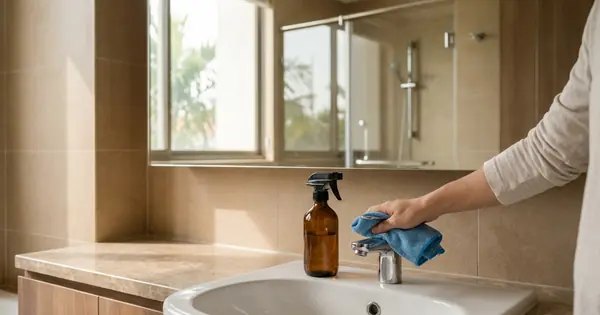
| 1 | Bathrooms | 20 minutes | Mirror streak-free under direct light; shower walls, grout and glass free of soap scum; fittings free of limescale; toilet clean inside, outside and underneath; bin emptied and relined |
| 2 | Bedrooms | 20 minutes | Bed made with a hotel-style fold; mattress vacuumed; under the bed and corners dust-free; fan blades, aircon vents, sockets and cables dusted; wardrobe fronts and handles wiped |
| 3 | Kitchen | 30 minutes | Top and underside of the cooker hood and its oil tray; hob, knobs and backsplash; countertop including under movable items; fridge and microwave inside and out; no lingering cooking smell |
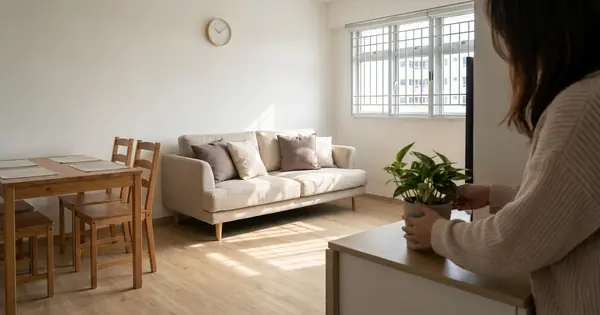
| 4 | Living and dining | 20 minutes | Sofa surface and the floor underneath; dining table including its underside; chairs aligned; TV console; window grilles and sills; door frames and light switches |
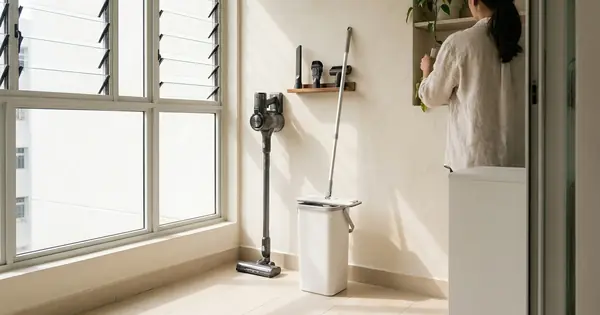
| 5 | Balcony | 20 minutes | Floor, corners and drain area; outdoor furniture; sliding door glass streak-free; rails and tracks free of grit |
| 6 | Laundry and ironing | 30 minutes | Clothes sorted by colour and fabric with pockets checked; washing machine drum, lint filter and rubber seal wiped; clothes dry before folding; collars, cuffs and hems ironed; iron switched off afterwards |
Bathrooms come first on the list. Starting there means the bathrooms are never the part that gets squeezed at the end of a visit. In most Singapore homes they hold the most detailed work, and humidity means soap scum and grime return quickly, so starting there protects the area people notice most.
Laundry and ironing is the last step, and it is done on request. If you do not want it, those 30 minutes go back to the rest of the home.
One cloth, one zone
The cloth system is the part of the standard most worth copying at home. The rule is short: one cloth, one zone. A cloth never crosses from one zone to another, which is how dirt and germs are kept from travelling around your home.
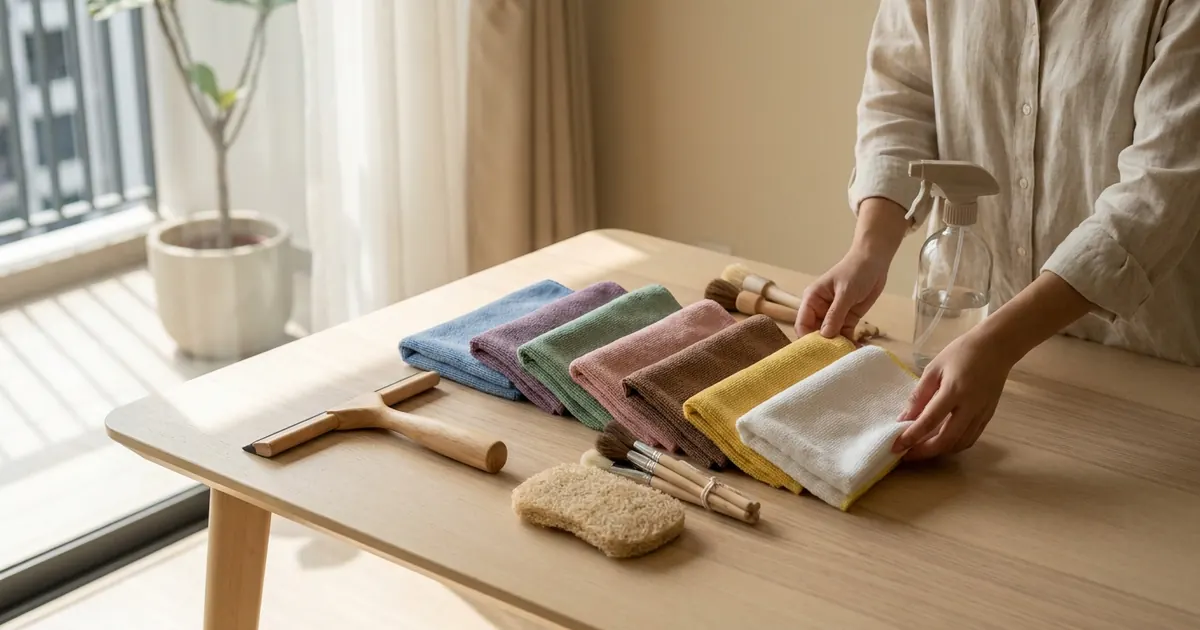
The cloths are part of the kit every HomeMaster cleaner brings: seven of them, each with a colour and a single job:
- Blue for bathroom surfaces, basins and the shower. It never leaves the bathroom.
- Purple for floors, skirting and corners only.
- Green, used dry, for dusting furniture, electronics and decor that skin does not touch.
- Pink, used damp, for furniture and surfaces people touch, such as the dining table.
- Kitchen wipes for grease, and a brown cloth for drying and polishing kitchen surfaces.
- Yellow, lint-free, for glass and mirrors, always used last.
You do not need to memorise the colours. What matters is the idea: the cloth that wiped around the toilet should never be the one that wipes the table where your children eat. Because the cloths arrive with your cleaner, the system comes with them. It is also worth copying for your own cleaning between visits: cloths in a few different colours make the rule easy to follow.
About 140 minutes: what fits in 2, 3 or 4 hours
The standard takes about 140 minutes to work through properly in one pass. Real homes vary: a second bathroom, a kitchen used for daily frying or a large basket of ironing all add time. Here is what that means for each session length.
| Visit | What usually fits |
|---|---|
| 2 hours | Less than the full standard. Choose priorities, for example bathrooms and kitchen, or every area except laundry and ironing |
| 3 hours | The full standard in a typical flat, with room for a second bathroom, some build-up or a little ironing |
| 4 hours | A first clean, a larger home, heavy build-up, or a full clean plus a meaningful amount of ironing |
A 2-hour visit is not a worse clean. It is a focused one, and it works well for a smaller home that is cleaned often, or when you only want the bathrooms and kitchen done properly. The mistake is booking 2 hours and expecting all six areas plus ironing. Our guide to how many cleaning hours a flat needs gives starting points by home type.
Using the checklist yourself
You can borrow the checkpoints to judge any clean, whether it was done by a cleaner, a family member or you. After a visit, spend two minutes on the places that give a rushed job away:
- Look at the bathroom mirror and shower glass with the light on. Streaks and a cloudy film show up at once.
- Check the base of the taps and the shower drain cover for limescale and hair.
- Lift one item on the kitchen counter, such as the kettle or a jar, and look underneath.
- Glance under the bed and behind the bedroom door.
- Run a finger along a window sill or grille.
If those are clean, the rest almost always is. If they are not, you now have specific words to use when you give feedback. The full room-by-room version is on our home cleaning checklist page, and our guide to what a home cleaner does covers the jobs that sit outside any cleaning checklist.
How it works with HomeMaster
Every HomeMaster cleaner is trained against this standard before their first job, and is background checked and reference verified. Sessions are 2, 3 or 4 hours with one cleaner per visit, so the standard is worked through steadily by one person rather than split across a crew.
Before a visit, tell Helen, our AI assistant on WhatsApp, which areas matter most this time, for example "bathrooms and kitchen first, ironing if there is time". She passes your priorities to your cleaner. If a checkpoint was genuinely missed, tell Helen: a quality miss is compensated with a voucher. You can see what a session covers on our home cleaning page.
Frequently asked questions
Does the cleaner complete all 75 checkpoints on every visit?
Only when the booked time allows it. The standard takes about 140 minutes to work through properly, so a 3-hour visit usually covers it in a typical flat, while a 2-hour visit covers your priorities. Tell Helen which areas come first so the most important work is never the part left out.
Is the checklist the same for an HDB flat, a condo and a landed home?
Yes. The six areas and the checkpoints are the same in every home. What changes is the time: more bathrooms, a bigger kitchen or more rooms need longer, which is why a larger home often needs a 4-hour visit or two visits close together.
Do I need to provide colour-coded cloths?
No. With HomeMaster, your cleaner brings seven colour-coded cloths as part of their kit, along with a squeegee, a non-scratch scrub pad, detail brushes, bin liners and a multi-purpose cleaner. You provide a working vacuum cleaner and mop, which a session cannot be completed without.
Why is laundry and ironing part of a cleaning checklist?
Because many households ask for it, and a standard should say what done properly means for every task. Laundry and ironing is included on request within the session time. If you do not want it, those 30 minutes of the standard go to the rest of the home.
Need a hand at home?
Tell Helen what you need on WhatsApp. She replies with real open times and the exact price, GST included, and weekends cost the same as weekdays.